
 MusicCo on Facebook
 MusicCo on Twitter
 MusicCo on MySpace
 Back to List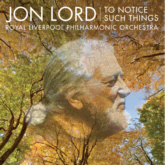
JON LORD'S NEW CLASSICAL ALBUM TO NOTICE SUCH THINGS TO BE RELEASED ON AVIE RECORDS 29 MARCH
Features Royal Liverpool Philharmonic Orchestra On Premiere Recordings of Four Works And Reading By Jeremy Irons With Lord On Piano
ALBUM IS TRIBUTE TO THE LATE JOHN MORTIMER, CBE, QC
Since leaving rock band Deep Purple in 2002, founding member and keyboard player Jon Lord has devoted his career to classical composing. The latest fruits of his labour can be heard on the new album, To Notice Such Things, to be released on 29 March on Avie Records (AV 2190). Jon reunites with the Royal Liverpool Philharmonic Orchestra, who made the world-premiere recording of his Durham Concerto (released on Avie in 2007), for four newly-recorded works. In addition, Jon accompanies Jeremy Irons who reads the Thomas Hardy poem "Afterwards", which provided inspiration for the title piece.
Andrew Cornall, Executive Director of the Royal Liverpool Philharmonic Orchestra comments, "Jon Lord's playing and music has been appreciated by millions over the years and following our first collaboration with him with our performances and recording of the Durham Concerto, we are delighted to be doing so again. This is a wonderful collection of Jon's latest music, and, once again, he shows that happy knack of communicating with his listener."
To Notice Such Things is a six-movement suite for solo flute, piano and string orchestra, composed in memory of Lord's close friend the late Sir John Mortimer, CBE, QC. Literary references are found throughout the work, appropriately for the creator of Rumpole of the Bailey. The music emanates from that which Lord composed for the stage show, Mortimer's Miscellany, which he also occasionally accompanied. To Notice Such Things is the last line of the Thomas Hardy poem "Afterwards", which ended the show. The first movement, As I Walked Out One Evening, from the W H Auden poem of the same name, is based on music that opened the revue. The second movement, At Court, captures the 60s and 70s heyday of the free-speaking barrister, whilst Turville Heath, where Mortimer lived, evokes the raconteur reposing in his well-loved garden. The peculiarly named The Stick Dance refers to the days when Mortimer's legs were failing him; he still loved a good jive but mainly observed the jiving of a female companion whilst supporting himself on his walking stick. The Winter of a Dormouse, which Jon describes as "an attempt to describe Sir John's final months", is a twist on Lord Byron's phrase "Summer of a Dormouse". Mortimer had chosen the diminutive creature to appear on his coat of arms. The work ends with Afterwards, a fitting mirror image to Mortimer's Miscellany.
Sir John's widow, Lady Penelope Mortimer: "My husband usually preferred the company of women to that of men but his friendship, in the last few years of his life, with Jon Lord was wonderful to behold - a meeting of minds and a fruitful companionship. I am thrilled that Jon has composed this beautiful music for John and that his spirit will live on through it."
Jon says of the piece, "I wanted to give the flute the job of "speaking" for John throughout the Suite; his laughter and his sighs, his wistfulness and occasional mild cantankerousness, his playfulness, and also the anguish and then the acceptance of his final days." The flute solo in To Notice Such Things, is eloquently performed by the Royal Liverpool Philharmonic Orchestra's principal flautist Cormac Henry, who throughout the work engages in dexterous musical dialogue with Lord's solo piano.
Jon Lord performed three movements from To Notice Such Things at Mortimer's memorial service at Southwark Cathedral in November 2009, in front of an audience that included the Duchess of Cornwall, members of the Mortimer family, Lord Mandelson, Lord Kinnock, Jeremy Paxman, Alan Rickman, Peter O'Toole, Sir Tom Stoppard and Jeremy Irons, whose noble reading of "Afterwards" closes the album. This recording serves as a lasting memento of a greatly admired and much loved Englishman.
The album proceeds with a gorgeous instrumental arrangement of Jon's Evening Song - the original version appears on his best-selling album Pictured Within - here substituting the vocal line with the mellow strains of alto flute and horn conjuring a gentle summer sunset. The next track, For Example, combines a yearning nostalgia with heartfelt homage. Written originally for the Trondheim Soloists, it is a "thank you" to one of Jon's early favourite composers, Edvard Grieg, whose initials provide the play on words of the title, and to Jon's piano teacher, who introduced him to the great Norwegian composer's music "way back when". A phrase from Grieg's charming and folksy Wedding Day at Troldhaugen is woven into the fabric of the work's final bars. Next is Air on a Blue String follows, a blues-meets-Bach fusion delivered with heart and soul. The album ends with Jeremy Irons' noble reading of the poem "Afterwards".
To Notice Such Things is the follow-up to Durham Concerto (AV 2145), which International Record Review found "beautifully scored" and "utterly confident in technique and wholly sincere", further saying, "Lord's basic language plugs directly into a long tradition of British folk-derived pastoral". A popular and critical success, Durham Concerto made the top 10 in the UK's Classical Artist Chart and was the highest new entry, at number 75, in Classic FM's 2009 Hall of Fame.
Classically trained from the age of 7, Jon has been recognised for his "considerable skill at imaginative soundscapes" (Gramophone). Fanfare magazine called him "an avid and accomplished composer", and The Times declared, "In the small but growing field of pop stars who write classical music, Lord is a clear leader."
To Notice Such Things has Jon's hallmark warm and melodic idiom, that beautiful and evocative style that has such broad appeal. The album will be available in stores, and through online and download destinations on 29 March 2010.
Jon Lord (b. 1941)
To Notice Such Things * Royal Liverpool Philharmonic Orchestra
In memoriam Sir John Mortimer, CBE, QC (1923 - 2009) Clark Rundell, conductor
1. As I Walked Out One Evening (4:15) Cormac Henry, flute *
2. At Court (5:33)
3. Turville Heath (3:01)
4. Stick Dance (4:45)
5. Winter of a Dormouse (5:33)
6. Afterwards (3:56)
7. Evening Song (8:16)
8. For Example (9:12)
9. Air on a Blue String (6:33)
Dedicated to Matthew Barley
10. "Afterwards" by Thomas Hardy
Read by Jeremy Irons
Jon Lord, piano
Total time: 54:25